commentary
stores
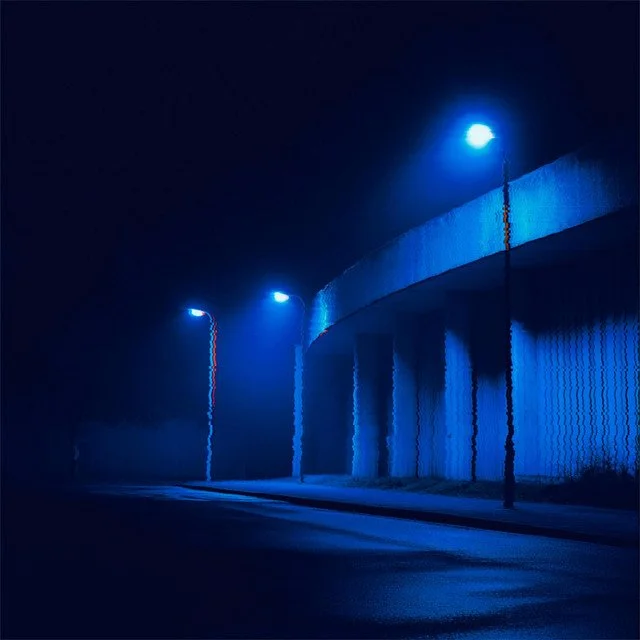
John had trouble sleeping. No matter the time of night, no matter how tightly the curtains were bound, and no matter how long he had shut his eyes for, John could not find darkness. Even when he pushed his head into the sheets, or locked one arm around his brow, and the other right below it – even when he knew that the moon was obscured by cloud, and the lights in the hallway had been turned off, and the porch light too, and the cars that passed by his building from time to time had all retired to their garages, with their engines turned off and their beams cooling, those cold, dark cars shut away in tight patterns along the cold, dark streets – even when there was no reflection even to the slick gutters wet from the afternoon rain, in John’s room, there was always light.
The form this light took was difficult for him to understand. It was not as if the light helped him see, but it was not hallucinogenic either – no fantasy arose from these vivid waves. Rather, it was simply a wash, a thin curtain of colour falling and falling across his vision. Regardless of whether his eyes were open or closed the slow heave of the curtain was ceaseless and distracting. This was agony. During these moments, a dark and red frustration would boil up in John’s chest. With as much strength as he could muster he would try to press it down, try to calm down so that sleep would come, but the redness would reach his brain and his thoughts would race wildly and badly, so much so that all he could do was clench his teeth and try to keep his breath even.
A doctor prescribed him fast dissolve Melatonin tablets, tiny white saucers that he slipped to the root of his tongue and swallowed quickly. They didn’t work. When he took them, he could feel the tablet travelling down his throat and into his chest and dissolving into a thousand smaller particles, weaving uncertain lines all through his body like a sheet of static. It made him anxious, and he stopped. He had never liked taking pills. The light continued to haunt him.
Then, in one dream, John visited the darkness he so longed for. It took the form of a single perfect circle.
He was standing on an endless liquid horizon facing a black hole. Its cool breath pressed and pulled his body. Along the water, the blackness was reflected into a thousand curved disks, straining and relaxing with the slight waves caused by the breath of the hole. He looked deep into the darkness and committed it to memory.
The next night, when confronted again with the dim curtain of colour, John imagined at the very centre of it a tiny pinprick of pure black, not so much more than a needle with a thread through it, a very black thread, sewn through the vast and empty corridor of light.
In his real life, John noticed traffic lights because even during the day they could be very black, and inside of them were the same perfect circles – perfect unblinking eyes. When he was driving he would catch one eye and then another, some of them telling him messages that he could not comprehend fully – aesthetic messages. And at night he would recall the perfect circles of these traffic lights: the pinprick he had initially imagined widened into a disk, and that too grew bigger, within the wall of invisible light. The fantasy of these perfect circles distracted him from his sleeplessness and they brought him solace. They mirrored exactly the monolith that he had begun to expect in his dreams every night – the obscure muscle that balanced itself upon the liquid horizon, which he sometimes thought of as an eye and then other times as a mouth.
He was at a party, and was not really focused, leaning on a wall with a tumbler of vodka cooling against his palm. Someone was talking to him but he was confused and not paying attention, just smiling and saying now and again “uh-huh”, “you’re right”, and “I know what you mean,” and when the person, who was really very young, said to him, “do you want to go somewhere,” he said again, “I know what you mean,” or a variant of that, and the person had lead him into a vehicle, and he found himself with his knees pressed against the dashboard of a small car, they were on a highway and it was deep night, and the person had their hand on his thigh but he couldn’t really tell where it was, or where it was going, let alone where he was, or where he was going, but he knew just like the traffic lights he was everywhere but he wasn’t really anywhere, that there was something important and true that this hand was trying to tell him, but it just so difficult for him to comprehend, those aesthetic messages.
“Do you notice,” he asked his friend later, “traffic lights, how freaky they can be?” And his friend Charlie said yes, she had always been afraid that a traffic light would one day trick her, would turn green when it really meant to stay red, or amber when it was really not about to change at all. Or she would forget which meant which, or she had this extremely real fear that she would go colour blind right there driving on a busy street, and because she could never remember whether the red light or the green light was the one on top, she would see the one on top turn on, and she would not know whether to stop or go, and she would die messily.
“Do you think they look like eyes,” he asked the person he had met at the party, when they were somewhere else, at another party maybe, on another night, “but not normal eyes, eyes that don’t have lids, eyes that go on seeing, forever, sending unreal messages,” and the person had asked him what he had taken, was it that green pill that was being handed around in the bathroom, and he said he couldn’t remember but it was unlikely because he hated taking pills. He contemplated silently why he was so comfortable talking in this wild way. He contemplated why he was the way he was fantasising before sleep every night these simple geometric shapes, and why they brought such terrible comfort to him.